

When adjusting a bike fit, most cyclists focus on saddle height and, with more experience, on saddle setback. However, one key component is often overlooked and has a direct impact on that setback: the seatpost.
An incorrect seatpost can prevent you from reaching the correct saddle position, even when the saddle and frame seem appropriate. In this article, we explain how the seatpost affects saddle setback, when it becomes a limitation, and how to fix it properly.
🚴♂️ What Is Saddle Setback?
Saddle setback is the horizontal distance between the bottom bracket axle and the saddle position.
This measurement directly affects:
- Knee position relative to the pedals
- Weight distribution between saddle, hands, and pedals
- Pedaling efficiency
- Long-term comfort
An incorrect setback can lead to knee pain, lower-back discomfort, or a constant feeling of being poorly positioned on the bike.
🧩 The Role of the Seatpost in Saddle Setback
The seatpost determines how far forward or backward the saddle can be positioned, even before adjusting the saddle on its rails.
There are two main types:
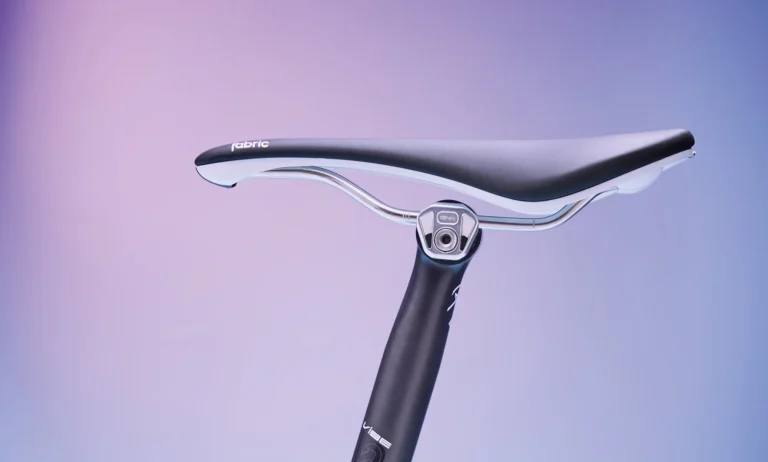
✔ Zero-offset (no setback) seatposts
The saddle clamp is aligned with the seatpost axis.
They allow a more forward saddle position.
✔ Setback seatposts (typically 15–25 mm)
The saddle clamp is positioned behind the seatpost axis.
They allow a more rearward saddle position.
👉 Key point:
The seatpost can add or remove setback before the saddle rails are even adjusted.
⚠️ What If I Can’t Reach the Correct Measurement?
This is a very common bike fitting issue.
❓
What if the saddle reaches its adjustment limit and I still can’t achieve the correct setback?
If the saddle is already at its maximum forward or backward limit and the setback is still incorrect, you should check the following:
🔍 Case 1: The saddle is all the way forward and the distance is still too long
This means you need less setback, but the saddle cannot move any further forward.
What to check:
✔ Seatpost type
- If the seatpost has setback, it is pushing the saddle too far back.
- The solution is usually to switch to a zero-offset seatpost.
✔ Frame size
- If even with a zero-offset seatpost the position is still too far back:
- The frame may be too large
- The effective reach may not suit your body proportions
👉 In this case, the issue is not the saddle, but the frame + seatpost combination.
🔍 Case 2: The saddle is all the way back and the distance is still too short
This is the opposite situation: you need more setback, but the saddle cannot move further back.
What to check:
✔ Seatpost type
- If you are using a zero-offset seatpost, you may not have enough rearward adjustment.
- The solution is usually to switch to a setback seatpost.
✔ Frame size
- If even with a setback seatpost you still can’t reach the correct measurement:
- The frame may be too small
- You may be trying to force a position the frame cannot provide
👉 In this case, the seatpost can help, but it cannot fully correct a major sizing issue.
🧠 Important: The Seatpost Is Not a Magic Fix
The seatpost allows for fine-tuning, but it should not be used to compensate for significant frame sizing or geometry problems.
A proper fitting process follows this order:
- Correct frame size
- Suitable frame geometry
- Correct seatpost (setback or zero-offset)
- Fine saddle adjustment on the rails
Reversing this order usually leads to compromises.
📌 Signs the Seatpost Might Be the Problem
- The saddle is positioned at the extreme end of the rails
- You never feel properly centered on the bike
- You change saddles but the issue remains
- The fit “works on paper” but not in real riding
In many cases, changing the seatpost solves the issue without changing the frame.
🏁 Final Thoughts
Saddle setback does not depend only on the saddle or its rail adjustment.
The seatpost plays a critical role and can be the difference between a correct position and one that never feels right.
Remember:
- Zero-offset seatposts move the saddle forward
- Setback seatposts move the saddle rearward
- If you hit the adjustment limit, check the seatpost first
- If the seatpost doesn’t solve it, reassess frame size
A good bike fit is not about forcing components to work, but about using the right components with the right frame geometry.